

Annual Market Salary Rate (AMSR) changes avoid the pitfalls of awards
/One of the more confusing aspects of nominations for skilled visas is determining the Annual Market Salary Rate (AMSR) and how this interacts with the income thresholds.
The AMSR regulation applies to all employer-sponsored nominations for the following skilled visas:
Subclass 482 – Skills in Demand visa,
Subclass 494 – Skilled Employer Sponsored Regional (Provisional) visa,
Subclass 186 – Employer Nominated Scheme visa,
Subclass 187 – Regional Sponsored Migration Scheme visa.
The AMSR requires evidence of what is paid to an equivalent Australian worker — which is either an Australian citizen or an Australian permanent resident employed in the same workplace, at the same location, and performing equivalent work — or what would be paid to an equivalent Australian worker if there is no equivalent Australian worker. Evidence of the AMSR is not required when a nominee’s annual earnings will be at least $250,000.
What the new instrument amends is the way the AMSR is calculated and provides alternative methods where a Fair Work instrument applies to the position.
There are very good reasons for this change. Fair Work instruments, such as modern awards, state industrial instruments or transitional instruments outline minimum pay and conditions and may not reflect the prevailing market rate. Additionally, the salaries of positions in many awards are under the minimum income thresholds, and the gap between these amounts is only likely to increase.
The current income thresholds are:
$76,515 for the temporary skilled migration income threshold: for 494 and 187 nomination applications
$76,515 for the core skills income threshold: for 482 nominations under the core skills stream and 186 nomination applications
$141,210 for the specialist skills income threshold: for 482 nominations under the specialist skills income threshold
A strict reading of how the AMSR is calculated before the amendment suggests that where a Fair Work instrument applies to the position the AMSR should be determined by what is, or would be, paid under that instrument. This would be so even if an equivalent worker is paid above the award wage.
This means that it does not matter whether there is an equivalent worker paid above the award, if the earnings under the award are less than the income threshold the nomination should be refused. This is even if an employer is willing to pay above the award. Many occupations cannot be approved under this arrangement if the earnings under the award are below the threshold.
The amendment now allows evidence other than the instrument. If there is an equivalent Australian worker, employment documents such as an employment contract and payslips can be used as a benchmark. If there no equivalent Australian worker, reputable evidence outside the business may be used such as recent job advertisements and remuneration surveys.
In either situation, the evidence cannot be less than the Fair Work instrument for the obvious reason that it would breaching minimum employment standards.
A nifty table is provided:
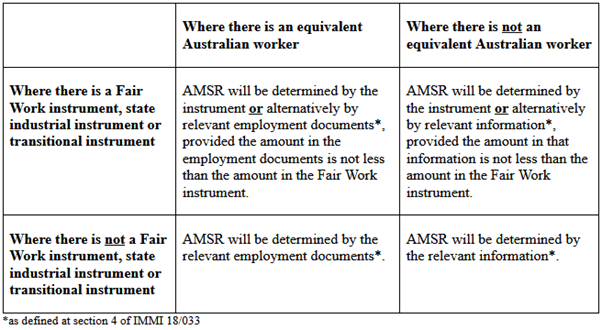
What employers can find hard to understand is how the AMSR, the relevant income threshold, and the nominee’s proposed earnings interact to satisfy these regulations. Setting aside the very few exemptions under policy, the simplest explanation is that the AMSR (however determined) must be at least the income threshold and the nominee’s annual earnings must be at least the AMSR. Reduced to a simple formula:
Income threshold ≤ AMSR ≤ nominee’s earnings
There are nuances to account for, though. A primary consideration is that the terms and conditions of the AMSR must be the same as those of the nominee to compare apples to apples. There are also discounts to the threshold for some labour agreements.
While this amendment commences from 25 March 2026, it is retrospective and applies to all nominations not finally determined. This perhaps shows that the previous determination was flawed from the outset.